Posted on 3 February 2026, following an email from Helen of Leamington Music dated from 31 January 2026:
Dear friends,
I write today to share with you the sad news that Leamington Music’s founder and Honorary President, Richard Phillips, passed away last night. He went peacefully, aged 85.
Richard was such a wonderful man – a true inspiration and an immense force for good in his unceasing championship of music. His incredible career in the arts has brought music to the ears and hearts of so many; from his first job at Sadler’s Wells Opera via the Yorkshire Arts Association, Warwick Arts Society, and Leamington Music, Richard created or directed 109 festivals including founding the York Early Music Festival and the Huddersfield Contemporary Music Festival and his amazing work earned him many much-deserved awards – not least the MBE for services to music and the arts in 2016.
Richard will be greatly missed by us all. The world is much the poorer today for his passing but, without doubt, so much the better for the amazing life he lived and the unparalleled legacy he leaves behind.
In fondest memory and friendship,
Helen
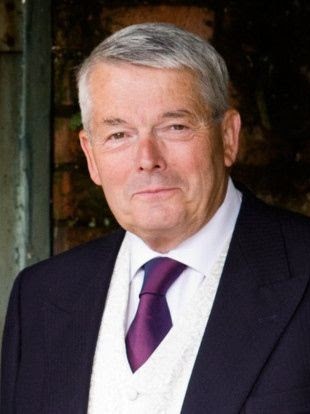
Richard Phillips was the patron of the Dvořák Society
Posted on 20 December 2025
Sad news reached the Society committee that Lewis Stevens passed on 16 December 2025.
Posted on 26 May 2025
Alena Veselá died on 11 May 2025 at the age of 101. She was a Czech organist and organ teacher, rector of the Janáček Academy of Performing Arts in Brno (JAMU) from 1990 to 1997.
DS Newsletter #143, pp. 1–2, celebrated Alena’s 100th Birthday.
Posted 20 April 2025
Today, the Dvořák Society Committee received the sad message that Mike Fage died a week ago in the Overgate Hospice in Elland.
Posted 3 December 2024
The death has occurred of Col. Fred O’Callaghan, who passed away in the early hours of Saturday 5 October 2024, six days short of his 97th birthday, at a nursing home in Dublin. He was a former member of the Dvořák Society (and possibly the first from Ireland!?) with membership no.309, which suggests that he registered at some time in the late 1980s.
Fred’s life combined the army and music. He entered the Irish Army School of Music as a fourteen-year-old ‘boy’ in 1942 and retired as a colonel and director of that institution at 60 in 1987, having served as a bandsman, instructor, composer and conductor along the way. His primary instrument was the piano, and he contributed to the musical life of Dublin as an accompanist, to singers especially, and also as a conductor of the country’s two leading orchestras and other ensembles. He proved an imaginative and energetic committee member, and he shared his knowledge and experience of music as an adjudicator at festivals and as a broadcaster on the national radio station.
Fred’s special relationship with Czech music began in 1975 when as conductor of the premier Irish army band he was invited to Prague for an international meeting. He immediately discovered an affinity with the country and its people, and for the next forty years he was a regular visitor to Prague and Brno, usually on his own but latterly on group trips organized by the Dvořák Society. A favourite pursuit of his was the hunt for old volumes and scores in second-hand bookshops, and he made the most of the very many opportunities to attend concerts and operas which musical life in the country offered. In his early 80s he attended a conference in Kromĕříž and delivered a paper on a work of profound import for him, Suk’s Asrael Symphony.
Those who knew Fred found him a true gentleman, reserved, highly intelligent, an avid reader of spiritual and philosophical literature and a passionate pacifist. He also possessed a keen sense of humour which manifested itself in company in which he felt at ease. Requiescat in pace!
Patrick Devine
Posted 28January 2023
Libor Pešek, a Czech classical music conductor best known for leading the Royal Liverpool Philharmonic Orchestra for a decade, has died aged 89.
He was a great supporter of music from Czech composers, above all Dvořák’s pupil and son-in-law Josef Suk. His recordings and concerts with the Royal Liverpool Philharmonic contributed to making Suk’s music known worldwide.
“It happened primarily because the time was right for presenting unknown pieces in Britain, even Czech pieces, and also it was still the right time to make some recordings,” he once said in an interview for Czech public radio.
Pešek was the principal conductor in Liverpool from 1987–1997, becoming conductor laureate thereafter. Under his charge, the northern English orchestra was dubbed “the best Czech orchestra this side of Prague”.
Pešek, who was born in Prague on June 22 1933, studied conducting, piano, cello and trombone at the Czech capital’s Academy of Music and Arts before embarking on an international conducting career that lasted more than 50 years. He led several orchestras in the Netherlands during the 1970s and headed the Slovak Philharmonic and was the conductor in residence of the Czech Philharmonic Orchestra in the 1980s. Later he was the principal guest conductor of the Prague Symphony Orchestra.
https://www.theguardian.com/music/2022/oct/28/libor- pesek-obituary
Posted 27 January 2020
Richard Beith (1935-2019)
The death at the end of last year of Richard Beith “denotes the loss of yet another Society stalwart.”
He was a long serving member of the National Committee, serving as Corporate Membership Secretary for nigh on 16 years. Richard was also the author/editor of Occasional Publication No1 with its discography of Rudolf Firkušný. In 2018 Occasional Publication No9 was a second and more extended volume of his original work.
Richard also made a substantial contribution to Occasional Publication No6, Vilém Tauský with discography, his own essay and editorship of the whole volume.
Throughout his long membership of the Dvořák Society, Richard wrote articles and record revues for our Newsletters. He helped with the necessary everyday tasks of stuffing envelopes and preparing postings. All this done with the minimum of fuss and plenty of good humour.
We shall miss him greatly and we send our sincerest condolences to his widow, Margaret.
(Shawn Pullman and Peter Herbert have written fuller tributes in Newsletter No130 on which these short comments are based.)
Posted 27 January 2020
Karel Werner (1925-2019)
Born in Jemnice, Moravia in 1925, Karel had an early interest in classical music and opera, in particular. He came to this country in 1968 at the time of the Warsaw Pact invasion of his homeland.
Together with his wife ,Marian, they travelled widely to operas all around the world and after 1989 back to the Czech Republic including some Society trips.
He had a lifelong interest in oriental philosophy and yoga and once in this country he was appointed Spalding Lecturer in Indian Philosophy and Religion at Durham University, writing many books and articles.
Throughout his membership of the Dvořák Society he was a familiar face with Marian at his side at events, concerts and on Society trips.
We shall miss him as a member and we send our condolences to Marian.
Posted 11 February 2019
On Saturday evening 2nd February 2019 we received the sad news of the death of Graham Melville Mason, the Society’s Patron. Graham would have been 86 on 4th March. Graham had contributed much to the Society over a long period having served as Chairman for 20 years until he stood down in 2007 and acting as Editor of the Society Journal until very recently. His knowledge and love of Czech and Slovak music was unparalleled and his expertise in the field gained him many friends and colleagues across the world.
A full tribute will appear in the Newsletter No 127 (April).

Posted 11 January 2019

John Tyrrell (1942–2018) by Nigel Simeone
John Tyrrell died in Beeston, Nottingham, on 4 October at the age of 76. He was born in Salisbury, Rhodesia (now Harare, Zimbabwe) and studied at Cape Town, then at Oxford where he wrote his PhD on Janáček’s operas. Author of several of the most important books on Janáček in any language, his vast learning was lightly worn – it was often shared in disc notes and programme books. Many others will have read his superbly informative essays for the Decca series of Janáček operas conducted by Charles Mackerras. He was also involved in that series in an editorial capacity, working with Mackerras on the edition of Jenůfa that stripped away Karel Kovařovic’s retouchings to present the opera in Janáček’s own orchestration. Recorded in 1982 as the last of Mackerras’s Decca series and published by Universal Edition in 1996, their version allowed us to hear an authentic Jenůfa for the first time and it quickly became the standard text of the opera. Tyrrell also worked extensively on From the House of the Dead and in a poignant parallel with Janáček’s own life, Tyrrell’s edition turned out to be his last major project. Tyrrell’s edition was finished before he died and first heard in its final form at the Royal Opera House in April 2018. When Tomáš Hanus conducted the trial performances of the edition at Welsh National Opera in October 2017, John invited a number of his friends to the premiere in Cardiff: it was a double celebration, of the opera and of John’s seventy-fifth birthday (which fell on 17 August 2017). Memories of our convivial gathering in a restaurant afterwards will be cherished by everyone who was there: John was the most modest of men, and for him the occasion was all in honour of the composer to whom he had devoted his working life.
Tyrrell’s book on Kát’a Kabanová (1982) was followed by his masterly survey of Czech Opera (1988); then came Janáček’s Operas: A Documentary Account (1992), the revelatory correspondence between Janáček and Kamila Stösslová in Intimate Letters (1994), My Life with Janáček: The Memoirs of Zdenka Janáčková (1998) and the magisterial two-volume biography, Janáček: Years of a Life (2006 and 2007) the first volume of which has already been published Czech. I had the extraordinary pleasure of co-writing two books with John. We collaborated on Janáček’s Works (1997, with Alena Němcová), the first comprehensive catalogue of Janáček’s music and writings, and working on this project was a joy from start to finish. John had been a mentor and friend ever since I first contacted him while I was a student in the 1970s and we often attended Janáček performances together over the years, as well as going to sadder occasions such as Charles Mackerras’s funeral. Soon after that we started our second collaboration, co-editing the book Charles Mackerras (2015), another immensely happy and untroubled collaboration. A month before he died, John took the time to read the draft of my latest book – wonderfully useful, and a typical act of kindness. As a university teacher he will be remembered with enormous affection and gratitude by students at Nottingham and Cardiff. John loved the music of many Czech composers – especially Dvořák and Suk – and he was an enthusiastic supporter of the Dvořák Society. As Janáček’s most devoted and inspiring chronicler, his work is a magnificent memorial; as the most loyal and generous of friends, he is irreplaceable.